
What Is Spot Welding?
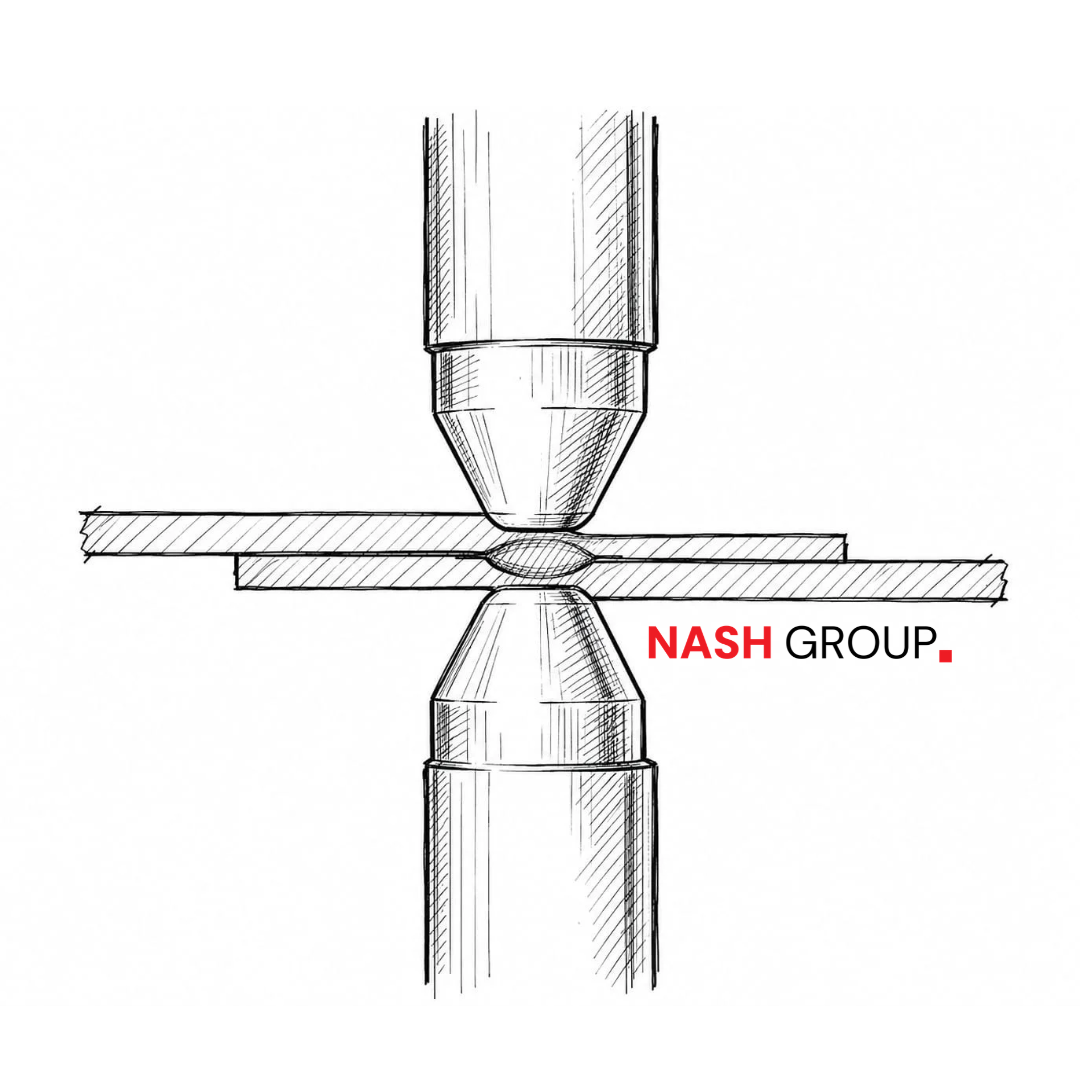
Spot welding is a way of joining two or more overlapping metal sheets at small points, or spots. The sheets are pressed together between two copper electrodes, and a strong electric current is passed through them for a fraction of a second. The metal heats up at that one spot, melts slightly and fuses into a small solid lump called a weld nugget.
Its full name is resistance spot welding, because the heat comes from the metal's own resistance to electricity. There is no flame, no arc to guide by hand, no filler wire and no shielding gas. Just pressure, current and time.
A simple way to picture it: think of the electrodes as a pair of tongs that pinch the sheets and push electricity through the pinch point. That point gets hot enough to melt, and the two sheets become one at that spot.
How Does Spot Welding Work?
Spot welding depends on three things working together: current, pressure and time.
When current flows through metal, the metal resists it and heats up, the same way the coil in an electric heater glows. The sheets resist the current most where they touch each other, so that is where heat builds up and the metal melts first. The copper electrodes conduct electricity very well and are cooled with water, so they stay relatively cool and do not melt into the sheet.
Each weld happens in four quick steps:
- Squeeze: The electrodes close and press the sheets firmly together.
- Weld: Current flows and the metal melts at the joint, forming the nugget.
- Hold: The current stops, but the pressure stays on while the nugget cools and solidifies.
- Release: The electrodes open and the part moves to the next spot.
The whole cycle usually takes well under a second. The current is very high, typically 5,000 to 15,000 amperes for steel, but the voltage is low, only a few volts.
A good weld comes from getting the balance right. Too little heat and the sheets only stick together without truly fusing. Too much and molten metal sprays out as sparks. Much of the work our engineers do at customer plants is finding that balance for each material and thickness.
Learn more about our solutions at NASH Robotics.
What Is a Spot Welding Machine Made Of?
Every spot welding machine, from a small workshop unit to a robotic gun on a car line, has the same basic parts:
- Transformer: Turns mains power into the very high current and low voltage that welding needs.
- Electrodes: Copper alloy tips that press on the sheets and carry the current. They wear with use and are regularly reshaped or replaced.
- Arms or gun: Hold the electrodes and apply pressure, using compressed air (pneumatic) or an electric motor (servo).
- Cooling system: Water flowing through the electrodes and transformer to carry heat away.
- Control panel: Where the operator sets the current, time and pressure for each job.
Types of Spot Welding Machines
Spot welding machines come in three main styles:
- Pedestal (press-type) machines: Fixed machines where the operator brings the part to the electrodes. Common in sheet metal fabrication, steel furniture and enclosure making.
- Portable spot welding guns: Hung from a balancer so the operator can take the gun to large parts, such as car bodies or big panels.
- Robotic spot welding: A welding gun mounted on an industrial robot, used where high volumes and consistent quality are needed. Most car bodies are welded this way today.
Machines also differ in the kind of power they use. AC machines are simple and economical, and work well for mild steel. MFDC (medium frequency DC) machines give smoother, more precise heat and suit galvanised steel, high-strength steel, aluminium and robotic welding.
At NASH Robotics, we offer both, and we help customers choose based on their parts rather than on price alone.
Where Is Spot Welding Used?
Spot welding is used wherever thin metal sheets need to be joined quickly, cheaply and in large numbers:
- Cars: A typical car body has several thousand spot welds.
- Two-wheelers and commercial vehicles: Frames, fuel tanks, cabins and body panels.
- Home appliances: Washing machines, refrigerators and microwave ovens.
- Electrical equipment: Control panels, enclosures and switchgear cabinets.
- Steel furniture: Almirahs, lockers, filing cabinets and racks.
- Railways: Coach body panels.
- Batteries: Connecting cells inside battery packs, including those used in electric vehicles.
Over the years, NASH Robotics has worked with a large number of manufacturers who rely on spot welding for products like these.
Advantages of Spot Welding
- Fast: Each weld takes a fraction of a second.
- Low running cost: No filler wire, gas or flux to buy.
- Easy to automate: Well suited to robots and production lines.
- Clean: Very little smoke and no slag compared with arc welding.
- Consistent: Once set up correctly, every weld comes out nearly the same.
- Low distortion: Heat stays in a small area, so thin sheets do not warp much.
Limitations of Spot Welding
- It only works on overlapping joints, not on edges butted together.
- It is most commonly used for sheets up to about 3 mm thick, although the suitable thickness depends on the material and machine.
- The electrodes need to reach both sides of the joint.
- Spot welds alone are not leak-tight. Joints that must seal need extra steps.
- A weak weld can look normal from outside, so regular testing is important.
Spot Welding vs MIG Welding
People often ask us which is better. The honest answer is that they do different jobs.
MIG welding melts a wire with an electric arc to lay down a continuous bead. It can join thick plates and many different joint shapes. Spot welding joins overlapping sheets at points, with no wire or gas.
For large volumes of thin sheet metal, spot welding is usually faster, cleaner and cheaper per joint. For thick sections, structural frames or sealed seams, MIG is often the better choice. Many factories use both.
Looking for resistance welding equipment for your manufacturing needs? Visit NASH Robotics to learn more about our products and solutions.
Frequently Asked Questions
Is Spot Welding Strong?
Yes. A correctly made spot weld is usually stronger than the sheet around it. When a good weld is pulled apart in a peel test, the sheet tears around the weld and leaves a round button of metal behind.
What Metals Can Be Spot Welded?
Low-carbon (mild) steel is the easiest. Galvanised steel, stainless steel, high-strength steel and aluminium can all be spot welded with the right machine and settings. Copper is difficult because it conducts electricity too well to heat up easily.
How Long Does a Spot Weld Take?
The current usually flows for only 0.1 to 0.5 seconds. Including squeeze and hold, a full weld cycle typically takes under a second.
Is Spot Welding Safe?
The voltage at the electrodes is low, but the process involves sparks, hot metal and strong clamping force. Machine guards, safety glasses, gloves and proper operator training are essential.
What Is the Difference Between Spot Welding and Resistance Welding?
Resistance welding is the family of processes that use electrical resistance to create heat. Spot welding is the most common type. Others include projection welding and seam welding.
For more information about resistance welding machines and automation solutions, visit NASH Robotics.