What Is Stud Welding? Understanding the Metal Fastening Process
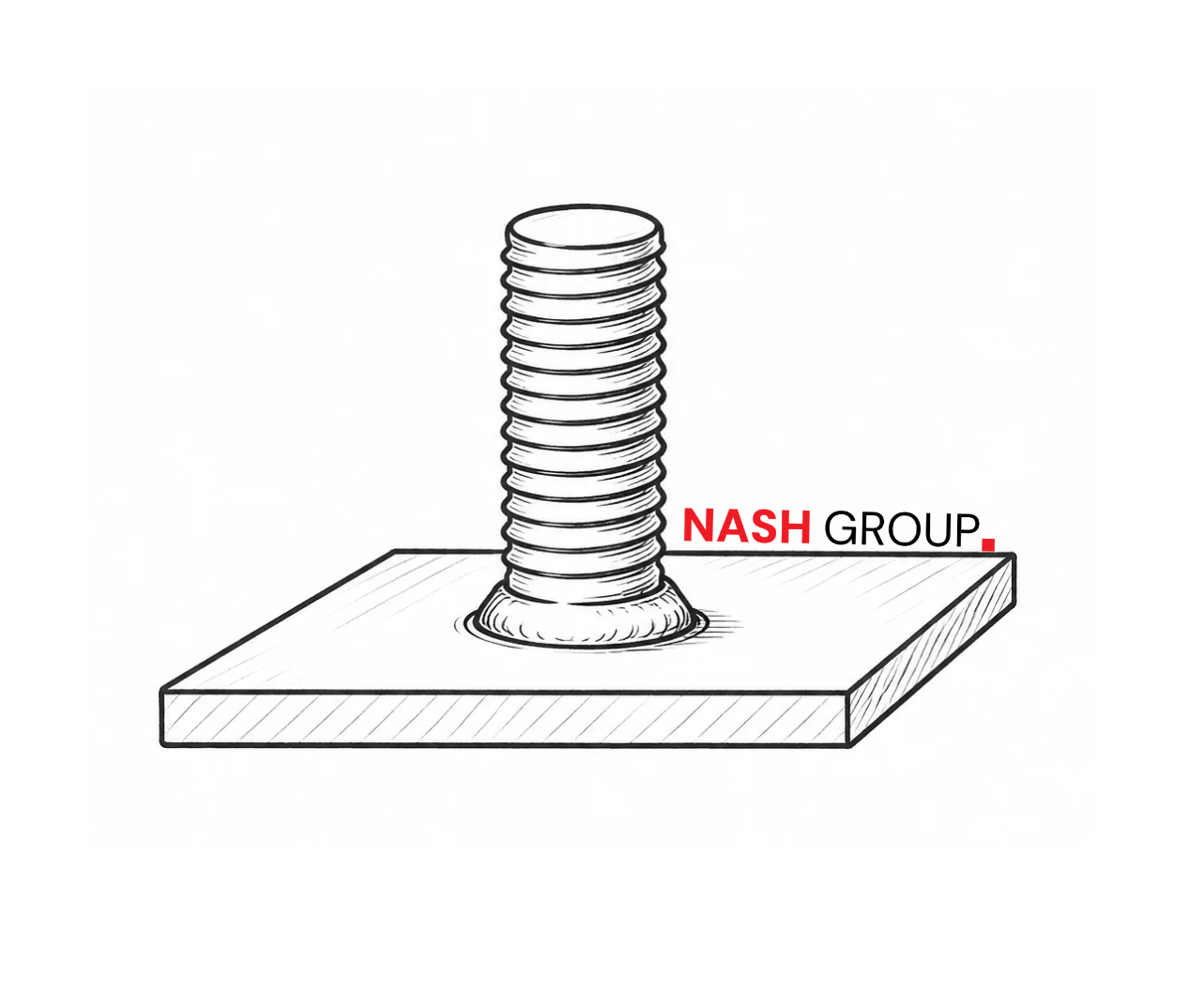
Stud welding is a process for welding a metal fastener, called a stud, directly onto a metal surface. The stud can be a threaded bolt, a plain pin, an internally threaded bush or a specially shaped part. Once welded, it becomes a permanent part of the workpiece and can be used to hold panels, cables, insulation, brackets and much more.
The big difference from other fastening methods is that you only need access to one side. There is no need to drill a hole, punch the sheet, tap a thread or hold a nut on the back. The stud goes on from the front, and the back surface stays sealed and, with some processes, almost unmarked.
How Does the Stud Welding Process Work?
Every stud welding process follows the same basic idea, whatever the machine:
- The stud is loaded into a stud welding gun and placed against the workpiece.
- The operator presses the trigger, and an electric arc forms between the end of the stud and the metal surface.
- The arc melts the end of the stud and a small pool on the surface.
- The gun pushes the stud into the molten pool.
- The metal solidifies, and the stud is welded across its full base.
The whole thing takes anywhere from a few milliseconds to around a second, depending on the process and stud size. A well-made stud weld is usually stronger than the stud itself, so if it is overloaded, the stud or the sheet gives way before the weld does.
What changes from one process to another is where the arc energy comes from, how long it lasts, and how the molten metal is protected. That is what separates the three main types of stud welding.
Types of Stud Welding Processes Used in Industry
There are three main stud welding processes: drawn arc, short cycle drawn arc and capacitor discharge (CD). Each suits a different range of stud sizes and sheet thicknesses.
1. Drawn Arc Stud Welding
Drawn arc stud welding is the workhorse for larger studs and thicker material.
The stud is placed against the plate, usually inside a ceramic ring called a ferrule. When the trigger is pressed, the gun lifts the stud slightly and an arc forms. The main welding current then takes over, melting the end of the stud and a pool in the plate. After a set time, typically from about 100 milliseconds to over a second, the gun plunges the stud into the pool.
The ferrule holds the molten metal in place, shapes a neat collar of weld around the base, and is broken off afterwards. Larger drawn arc studs usually have a small amount of flux at the tip to keep the weld clean.
Drawn arc handles studs larger in diameter, and copes better than other processes with slightly uneven or less-than-perfect surfaces. Some systems use shielding gas instead of a ferrule. It is the process used for shear connectors in steel and concrete construction, heavy fabrication, shipbuilding and boiler work.
2. Short Cycle Drawn Arc Stud Welding
Short cycle is a faster version of drawn arc stud welding. It uses a much higher current for a much shorter time, typically 10 to 100 milliseconds. Because the weld happens so quickly, there is no need for a ceramic ferrule, although shielding gas is often used to improve the weld collar, especially on stainless steel.
Short cycle is suited to studs up to about 12 mm on thinner sheet than standard drawn arc can handle. It is widely used in automotive body shops and high-volume production, where studs are fed automatically and welded by hand-held guns or robots.
3. Capacitor Discharge (CD) Stud Welding
Capacitor discharge (CD) stud welding stores energy in a bank of capacitors and releases it all in a few milliseconds. The studs have a small tip, or pip, on the weld end. When the capacitors discharge, the tip vaporises, an arc forms, and the stud is pressed into the melted surface.
Because the weld is so fast, very little heat spreads into the sheet. This means CD can weld studs onto thin sheet, down to around 0.5 mm, with little or no marking on the back side. That makes it ideal for painted, polished or visible surfaces such as electrical enclosures, kitchen equipment, signage and appliance panels.
It works on mild steel, stainless steel, aluminium and brass, and the machines are compact and run on single-phase power.
CD welding comes in two methods:
- Contact Method: The stud tip touches the sheet before the weld starts. Simple and common for steel and stainless steel.
- Gap Method: The stud is held just off the surface and driven onto it when triggered. The weld is even quicker, which limits oxidation and suits aluminium and brass better.
CD studs typically range from about 3 mm to 10 mm in diameter. The surface needs to be clean and flat for consistent results. Nash Robotics also builds CD stud welders for exactly this kind of thin-sheet work.
Comparison of Drawn Arc, Short Cycle and CD Stud Welding
Choosing the right stud welding process depends on stud diameter, base material thickness, surface finish and production requirements. The following table provides a quick comparison:
| Parameter | Drawn Arc | Short Cycle | Capacitor Discharge (CD) |
|---|---|---|---|
| Typical stud diameter | 3 to 25 mm | 3 to 12 mm | 3 to 10 mm |
| Weld time | About 100 ms to over 1 s | 10 to 100 ms | A few milliseconds |
| Minimum sheet thickness (rough guide) | About 1/4 of stud diameter | About 1/8 of stud diameter | About 1/10 of stud diameter |
| Weld protection | Ceramic ferrule or shielding gas | None or shielding gas | None needed |
| Marking on back side | Visible | Some | Minimal |
| Best for | Thick plate, structural and heavy-duty studs | Automotive and high-volume work on thinner sheet | Thin, finished or visible panels |
These figures are typical working ranges. Exact limits depend on the material, stud design and machine, so it is always worth running sample welds on your own parts.
Industrial Applications of Stud Welding Across Different Industries
Stud welding is widely used across industries that work with metal components and assemblies. Some common applications include:
- Automotive Industry: Earth studs, T-studs and fixing points for wiring harnesses, brake lines, heat shields and trim.
- Railways and Metro Coaches: Studs for fixing floors, interior panels, cable trays and equipment to the coach body.
- Construction and Bridges: Shear connectors on steel beams and metal decking.
- Electrical Panels and Enclosures: Mounting studs and earth studs, usually by CD so the outside of the panel stays clean.
- Shipbuilding: Insulation pins, deck fittings and fixing points.
- Boilers and Power Plants: Insulation pins and refractory anchors.
- HVAC Industry: Insulation pins on ducts and fixing points on housings.
- Appliances, Kitchen Equipment and Signage: Hidden fixings on stainless steel and painted panels.
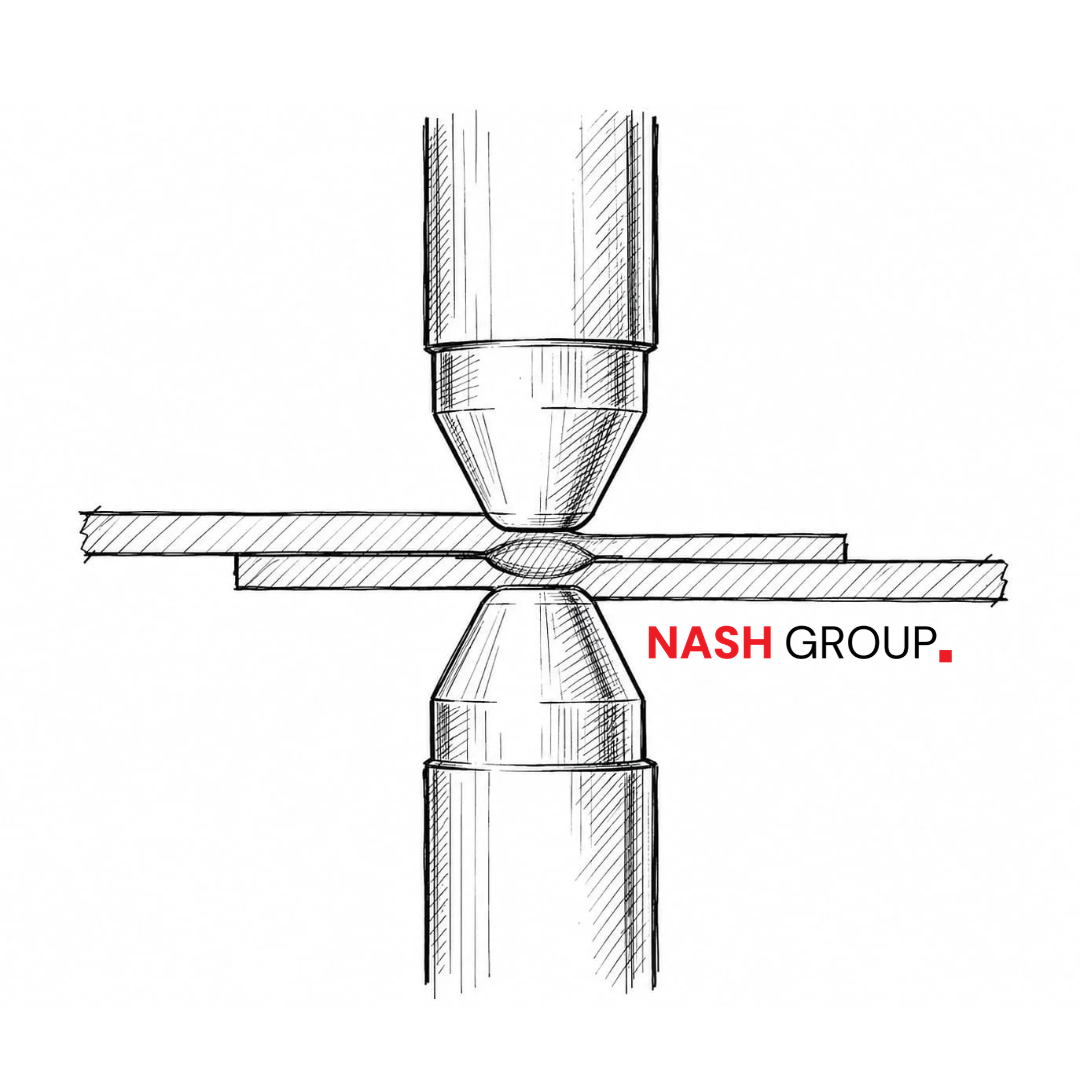
Over more than 45 years in welding, the Nash Robotics team has worked with a large number of manufacturers, from automotive body shops to metro coach builders. In many of those plants, stud welding sits right alongside spot and projection welding on the same production line.
Key Advantages of Stud Welding in Manufacturing
Stud welding offers several advantages over conventional fastening methods, making it a preferred solution for many industrial applications.
- One-Sided Access: No need to reach the back of the part.
- No Holes Required: Nothing to drill, punch or tap, so there are no leak paths and no weakening of the sheet.
- High-Speed Welding: Each stud is welded in a fraction of a second, making stud welding far quicker than drilling and bolting.
- Strong and Reliable Joints: A good weld is usually stronger than the stud itself.
- Clean Surface Finish: With CD stud welding, the visible side of the sheet stays almost unmarked.
- Automation Friendly: With automatic feeders and robots, studs can be welded at high speed with consistent quality.
How to Choose the Right Industrial Stud Welding Machine
Selecting the right stud welding machine and process is important for achieving consistent weld quality and production efficiency. The questions our team at Nash Robotics asks first are always the same:
- What stud size do you need? Above about 10 to 12 mm, drawn arc is usually the only option.
- How thick is the base material? Thin sheet points to CD or short cycle. Thick plate points to drawn arc.
- Does the back side need to stay clean? If it is a visible or painted surface, CD is the safe choice.
- What is the material? The base material and stud material help determine the suitable welding process.
- How many studs a day? High volumes justify automatic stud feeding, and often a robotic stud welding cell.
In our experience, most stud welding problems come from choosing a process on price instead of on the job. A CD machine is cheaper, but it will not give reliable welds on M12 studs on thick plate. A drawn arc machine is powerful, but it will mark the back of a 1 mm stainless panel.
Nash Robotics: Stud Welding Machines and Automation Solutions
At Nash Robotics, our stud welding machines, guns and feeders are designed by our own engineering team and built at our facility in Nashik.
Our product and solution range includes:
- Stud Welding Machines: Including drawn arc and capacitor discharge (CD) stud welders.
- Stud Welding Guns: For manual and automated use.
- Automatic Bowl Feeders: For studs, bolts and nuts, so fasteners reach the gun automatically and in the right orientation.
- Robotic Stud Welding Cells: Special-purpose robotic solutions for customers who want to automate fully.
Because the design, electrical work, mechanical assembly and testing all happen under one roof, we can adapt a machine to a customer's part instead of asking the customer to adapt to the machine.
Every component goes through our quality inspection, and every machine is run through welding trials before it leaves the factory.
Working in-house also means faster support. When a customer needs a spare, a modification or help setting up a new stud size, they are talking directly to the people who built the machine. Nash Robotics is part of the wider Nash Group, which has been building welding and automation equipment for customers in India and abroad for more than four decades.
Get in Touch with Nash Robotics for Stud Welding Solutions
Whether you are welding a few earth studs on panels or thousands of studs a day on a body shop line, the right process and machine make all the difference.
The Nash Robotics team can look at your parts, recommend the right stud welding process, and run sample welds before you decide.
Talk to our stud welding team about manual stud welders, automatic stud feeding or a complete robotic stud welding cell.